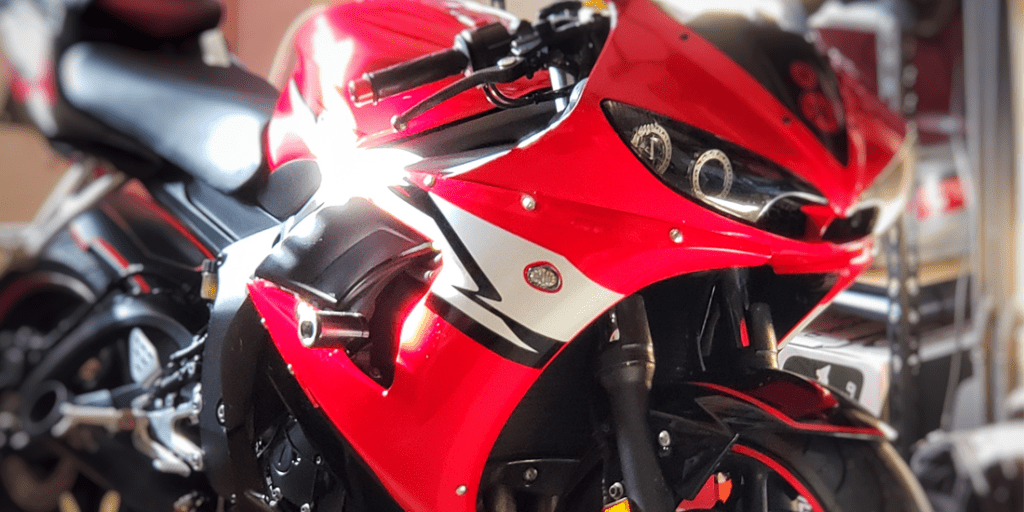
Starting a motorcycle is easier than it used to be, thanks to technology. While there are various kinds of bikes, starting a Yamaha R6 or other fuel-injected motorcycles is more or less then same across the board.
Here is how you start a fuel-injected motorcycle, like the Yamaha R6:
Starting The Engine of a Yamaha R6
You can find this information in the owner’s manual of your bike, too. Before starting the bike, make sure you have done the following:
- The transmission is in neutral.
- The transmission is in gear, the clutch is pulled, and the kickstand/sidestand is stowed. Some modern models, Yamaha included, have a safety feature that will prevent the bike from starting if the sidestand hasn’t been raised.
Next, follow these steps precisely:
- Insert the key into the ignition.
- Turn the key to the ON position. Make sure the engine stop switch is set to the correct position.
- Warning lights and indicator lights should illuminate momentarily then disappear if conditions are satisfactory. These lights include:
- Oil level
- Coolant temperature
- Fuel level
- Shift timing
- Engine problems
- Immobilizer system
- Shift the transmission into neutral. The light should come on. If not, you might have an electrical circuit problem.
- Start the engine with the start switch.
- In the event of failure, wait a few seconds and try another start. Don’t draw out the time trying to start the engine to preserve battery power. Do not extend for more than 10 seconds.
General Instructions for a Fuel-Injected Motorcycle
Here’s some instructions to follow if you don’t have the make/model mentioned above:
How To Start A Motorcycle
- Put the motorcycle in neutral. Neutral is always located between 1st and 2nd gear.
- Put the key in the ignition if necessary.
* Note: Fuel-injected motorcycles have an engine management system. This means you don’t have to worry about using the choke lever. Only a small amount of throttle will be needed, regardless of engine temperature. - Start pulling the clutch near the left handlebar. Some riders choose to pull the clutch and front brake simultaneously, but the choice is yours.
- Press and hold the start button. You will find this on the right handlebar. Maintain your hold on the clutch.
- The motorcycle should automatically catch and start.
- If the engine doesn’t turn over and start immediately, you can try using the throttle while pressing the start button. Make sure you are holding the clutch.
- Remember to never crank the engine for more than 10 seconds clips at a time. Otherwise, you’re wasting battery power.
- You can slowly start to release the clutch.
Now, you’re ready to ride!
Final Thoughts
Unlike carburetor motors, fuel injection systems rarely fail. To prevent the pump from failing, do some routine maintenance. Get into the habit of listening to the bike and know what a healthy running engine sounds like. That way, if something unusual happens, you will be able to tell whether or not something is wrong with the pump fuse by sound alone.
Modern fuel-injected motorcycles are easy to start. Follow the instructions in this article, and you will have no problem.
For more information about how to start, ride, and care for your motorcycle, check out my YouTube channel. Hit the subscribe button for notifications whenever there’s an update.
You Might also like
-
How To Install A Voodoo Slip-On Exhaust
There are multiple reasons that people want to replace the stock mufflers that came installed on their motorcycles and replace them with aftermarket exhausts. Whether your muffler has become worn or you simply want to upgrade to a better-performing exhaust, replacing it is something that is commonly done by motorcycle owners everywhere. Here is how you can install the Voodoo Slip-On Exhaust.
1. Read the instructions until you understand them
Before you get started, make sure that you read the instructions and that you understand them. You shouldn’t dive in until you are certain that you understand what you are doing. Then, gather together the tools that you will need to install your new exhaust.
2. Loosen the joint where it connects
The way in which your muffler is connected will depend on the motorcycle that you own. You may be looking for a gasketed flange joint or a band clamp. When you find the joint, loosen it so that you can get ready to remove your old muffler.
3. Loosen the bracket for the muffler
After you have loosened the connection joint, you will next need to loosen the brackets for your muffler. You will need to make certain that you provide support to the muffler while you are loosening its bracket. If you don’t, the muffler may strike other parts on your motorcycle and cause some damage.
4. Take the old muffler off of your motorcycle
While mufflers for motorcycles are called slip-ons, removing your old muffler may still require you to use some force to dislodge it from your bike. After you have taken the old muffler off, store it somewhere safe.
5. Take your new muffler and slide it over your header pipe
You will be doing the same steps that you just completed when you install your new muffler, but you will be doing them in reverse. If you find that you are having trouble, stop and think about what you are doing.
6. Securing your new muffler
You will secure your new Voodoo exhaust by attaching it with band-style clamps or with brackets. If you have band-style clamps, they will work by tightening around your muffler to hold it in place. Brackets attach to both your motorcycle and your muffler. Make certain that you familiarize yourself with the instructions before trying to secure your muffler. If you have brackets, try tightening them with your fingers first so that you are less likely to damage the parts. After everything is in its proper place, reattach the gasket clamps, flanges or springs that you need to attach the muffler to your head pipe. Make sure that you do not use too much torque.
7. Wipe your new exhaust down
Before you hop on your motorcycle, make sure that you wipe your new muffler down to remove the oils that you left behind during the installation. If you don’t, it may be stained when it runs with the oils on the surface.
8. Look for leaks
Turn on your motorcycle and let it run while you look at it for leaks. You should check the top of the headers and the base of your slip-on exhaust.
Legal issues
Make sure that you understand what the law in your area requires for modifications to your motorcycle’s exhaust. Some modifications are only allowed off of the highways in some states.
Installing your new Voodoo Slip-On Exhaust is a relatively straightforward process. If you make certain to read the manuals and that you understand the laws in your area, you can soon have a great-looking and sounding muffler on your bike. -
How To Use A Battery Tender®
One of the most heartbreaking situations any car or motorcycle lover will experience is when you have beautiful riding or driving weather, are excited to hit the road, and the engine doesn’t turnover. The reason? Low battery power.
If you have a nifty gadget called a Battery Tender®, you can recharge the battery and bring it back to life in no time. A Battery Tender® is a friendlier alternative to traditional battery charges because of the technology housed within the device that is designed to prolong battery life.
Before you decide to buy a Battery Tender®/Maintainer, though, let’s talk about what they are, what battery maintainters do, and why you should have a maintenance charger for your motorcycle.
No products found.No products found.
What Is A Battery Tender®?
Also known as “float chargers” or “maintenance chargers,” Battery Tender® were first created by the U.S. company Deltran in 1965. What separates battery tenders from plain ol’ chargers is that these devices provide a constant voltage supply but also are controlled by processors. In other words, they are able to refrain from charging faulty batteries, use spark-free technology, and have green and red indicators that help you understand what’s happening in just a glimpse.
A Battery Tender® is the opposite of a trickle charger, an unsophisticated, less expensive option. Though the purpose is similar, a trickle charger doesn’t have microprocessor technology that prevents it from damaging the battery if you leave it charging for an extended period of time. Furthermore, you can use a battery tender when you plan on storing your motorcycle for several weeks on end, like over winter.
Keep in mind that a Battery Tender® is not able to jump-start a long-dead battery. When this happens, you need a trickle charger.
For this reason, you can think of a Battery Tender® as a trickle charge with a brain—the exact words of the original manufacturer, Deltran. Of course, there is more than one brand of Battery Tender® available on the market.
For example, the DieHard Battery Charger/Maintainer is similar to a Battery Tender that employs things like Float Mode Monitoring to charge more than just motorcycles. Whichever model you choose, just make sure they have features like auto-adjust amperage to help maintain the charge, easy-to-read indicator lights, and float mode monitoring.
No products found.No products found.
Using A Battery Tender®
Operating a Battery Tender® is easy. To use a one of these devices, you just plug it into any standard AC outlet and use it to transfer power to the 12-volt battery in your motorcycle.
When preparing to use the battery tender, keep the AC and DC cords away from the vehicle. Keep the charger off until you have everything plugged in.
Depending on the motorcycle, the connections might differ, so refer to your owner manual. Once you have the battery tender connected to the correct posts on the battery, you can switch it on.
You should see indicator lights turn on, such as:
• Flashing red light – AC power and microprocessor is functioning properly. However, if the flashing continues, the voltage might be too low. Take a look to make sure the alligator clips are attached properly.
• Steady red light – The clamps are properly place and power is being transferred to your battery. The light will remain red until the battery is fully charged.
• Flashing green light – A flashing green light is often paired with a red light. This means the battery is about 80% charged and can be used.
• Steady green light – The charge is complete. You can keep the battery tender attached to the battery to help maintain the life of the battery if it will be sitting for an extended period of time.Quick note: If your battery has less than 3 volts, the battery tender won’t start. The battery should produce at least 3 volts. On the same note, if you have a standard 12 volt battery that is defunct and is producing less than 9 volts, the battery tender won’t work properly.
No products found.
Takeaway
Trickle chargers bring dead batteries back to life while battery tenders prevent batteries from losing power during periods of inactivity. Whether you use your bike every other day or less frequently, a battery tender will preserve the life of the battery to ensure your motorcycle is ready to ride whenever you need to hit the road. The straightforward usage makes it a wonderful investment for every motorcycle enthusiast.
Now that you’ve done you’re reading, it’s time to check out the motorcycle videos on my YouTube channel. Don’t forget to subscribe and receive notifications so you never miss an update!
No products found.
No products found.
-
More Than Just a Number: Evaluating Motorcycle Performance Beyond Top Speed
In the world of motorcycles, the allure of top speed is undeniable. Images of sleek machines blurring across racetracks and boasting impressive numbers often dominate the conversation. However, for many riders, true performance goes beyond simply hitting the highest speedometer reading. Just like a good book isn’t judged solely by its length, a motorcycle’s true capabilities extend far beyond a single metric.
Key Takeaways
- Top speed isn’t the only measure of motorcycle performance. Consider factors like acceleration, handling, braking performance, and power-to-weight ratio to find the perfect bike for your needs.
- Different riding styles prioritize different performance aspects: acceleration for city riding, handling for navigation, braking for safety, and power-to-weight ratio for sport riding.
- Choose a motorcycle that aligns with your individual riding style and preferences for the most enjoyable and fulfilling experience.
Comparison Table: Conventional vs. Unconventional Motorcycle Performance Measures
Feature Conventional Unconventional Focus Top Speed Acceleration, Handling, Braking, Power-to-Weight Ratio Relevance Limited More comprehensive picture, caters to various riding styles Examples MPH (km/h) 0-60 mph (0-100 km/h) time, suspension travel, braking distance, horsepower per kilogram This article delves deeper, exploring unconventional measures of motorcycle performance that cater to various riding styles and needs. While top speed has its place, focusing solely on this number can paint an incomplete picture of a motorcycle’s true potential. Here are some key performance factors to consider:
1. Acceleration:
The thrill of the launch, the surge of power as you twist the throttle, is an essential part of the riding experience. Acceleration, measured in seconds from 0 to 60 mph or 0 to 100 km/h, indicates how quickly a motorcycle can gain speed. This metric is particularly important for city riding and overtaking maneuvers, offering confidence and responsiveness in everyday situations.
2. Handling:
The ability of a motorcycle to carve through corners with precision and stability is crucial for a confident and enjoyable ride. Handling encompasses factors like suspension, steering geometry, and tire grip. A well-handling motorcycle feels planted and predictable, allowing riders to navigate curves confidently and explore the twisties with ease.
3. Braking Performance:
The ability to slow down effectively and safely is paramount for any motorcycle. Braking performance is measured by the distance it takes a motorcycle to come to a complete stop from a specific speed. Powerful and responsive brakes inspire confidence, especially on mountain roads or in unexpected situations.
4. Power-to-Weight Ratio:
This metric combines engine power and motorcycle weight. A higher power-to-weight ratio signifies a lighter bike with more power, translating to better acceleration, agility, and overall responsiveness. This factor is especially relevant for sport-oriented riding and track days, where quick maneuvering and responsiveness are crucial.
Finding the Right Balance:
The ideal combination of these performance metrics depends on your individual riding style and preferences. Tourers might prioritize comfort and long-distance capabilities, while track riders might seek razor-sharp handling and agile responsiveness.
6 FAQs About Unconventional Motorcycle Performance Measures
1. What’s the difference between horsepower and torque?
Horsepower measures an engine’s ability to generate power, while torque measures its twisting force. Both contribute to a motorcycle’s performance, with a good balance being ideal.
2. How does suspension affect handling?
Suspension plays a crucial role in absorbing bumps and maintaining tire contact with the road, leading to improved stability and control.
3. Are ABS brakes important?
Anti-lock braking systems (ABS) help prevent wheel lockup during hard braking, providing increased control and shorter stopping distances, especially in slippery conditions.
4. What’s the ideal power-to-weight ratio for me?
A higher power-to-weight ratio generally translates to better acceleration and agility. However, consider your riding style and skill level. A lighter, more powerful bike might be harder to handle for beginners.
5. How can I test a motorcycle’s performance before buying?
Many dealerships offer test rides so you can experience the motorcycle’s performance firsthand. Consider different models and riding scenarios to find the best fit.
6. What are some safety considerations when evaluating motorcycle performance?
Always prioritize safety first. Focus on factors like braking performance, handling, and visibility to ensure a safe and enjoyable riding experience.
Facts & Statistics: Motorcycle Usage and Performance Preferences
- 70% of motorcycle owners use their bikes for leisure riding. (https://www.statista.com/study/91633/motorcycles-report/)
- 30% of motorcycle owners commute to work on their bikes. (https://www.statista.com/study/91633/motorcycles-report/)
- Among sportbike owners, 65% prioritize handling and agility, while 42% prioritize acceleration. (https://www.statista.com/study/91633/motorcycles-report/)
By understanding these unconventional measures and evaluating them against your needs, you can make a more informed decision when choosing a motorcycle that perfectly aligns with your riding experience. Remember, the fastest motorcycle on the market isn’t always the “best” for everyone. Ultimately, the perfect motorcycle is the one that delivers the performance characteristics that bring you the most enjoyment and confidence on the road.